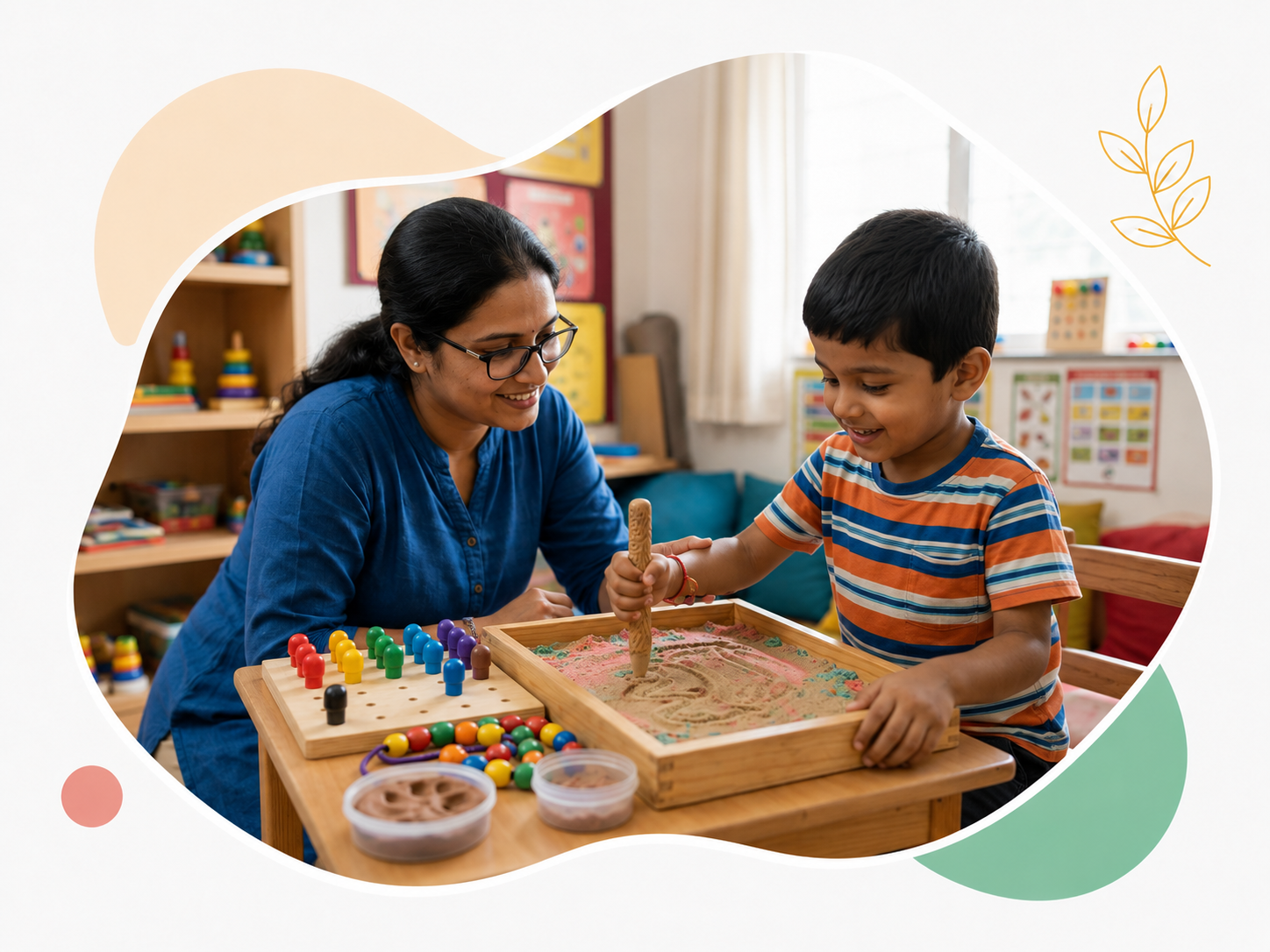
How Occupational Therapy Builds the Foundation for Prewriting Skills

What is Occupational Therapy

Occupational therapy is a client-centered health profession concerned with promoting health and well-being through occupation. The primary goal of occupational therapy is to enable people to participate in the activities of everyday life.

The Occupational Therapy Department of Early Autism Ventures offers occupational therapy services in an educational setting with a diverse work environment. Areas of expertise are pediatric care and rehabilitation

Identifying the need for Occupational Therapy/ When Can We Help?

Does your child face difficulties with day-to-day activities at home, school, or in the community?
If you answered yes, there’s a high likelihood that your child could reap significant benefits from occupational therapy services!
Occupational Therapists are highly trained healthcare professionals that evaluate and assist children that are having difficulty participating in meaningful activities or “occupations” that are needed to conduct their daily routines and live their life to the fullest. Some areas that occupational therapy can help with include:


  • Fine motor skills
  • Gross motor skills
  • Motor planning skills
  • Sensory processing difficulties
  • Visual motor and visual perceptual skills
  • Self-care
  • Prewriting and handwriting skills
  • Oral motor challenge’s
  • Problems with self-regulating, transitioning, or engaging with peers
  • Struggling to achieve age-appropriate milestones
We serve to a wide range of conditions including :

  • Autism
  • Down’s Syndrom
  • Celebral Palsy
  • ADHD
  • Learning Disablity
  • Sensory Processing Disorder

Services Offered at OT Department (EAV) :

Sensory Integration

Occupational therapists can help children with sensory processing differences to regulate and integrate sensory information. Through sensory-based interventions, OT can help children improve the processing and integration of sensory inputs in order to gain appropriate adaptive responses to everyday stimuli. As a result, the approach not only improves the child’s ability to engage in daily activities, but also enables them to navigate their environment effectively.

Why is Sensory Integration Needed?

Many children with sensory integrative problems develop a tendency to avoid or reject simple sensory/motor challenges, responding with refusals or tantrums when asked to perform.

If this becomes a long-term pattern of behavior, the child may miss important experiences, such as playing games with peers that are critical in building feelings of competency, mastering a wide repertoire of useful skills, and developing flexible social strategies.

Children can present with different types of sensory integration difficulties (also known as sensory processing difficulties):

  • Hyper (over) sensitive
    • Fear of heights
    • Dislike of touch experiences eg. nail cutting, messy play, hair cutting
    • Dislike of loud and sudden sounds
    • Avoidance of playground equipment (swings and slides)
  • Hypo (under) sensitive
    • Appears to have no fear or doesn’t feel pain
    • Seeks movement or touch opportunities (fidgets, rocks, runs about, leans on peers)
    • Mouths or chews things
    • Poor attention to the environment or people around
  • Motor Planning (Praxis)
    • Appears clumsy
    • Difficulty creating movement ideas
    • Difficulty planning and executing new movements
  • Poor posture
    • Slouches at desk
    • Fidgets/difficulty sitting in one position for an extended period
    • Impact on fine motor coordination & ball skills
    • Poor balance

Sensory integration provides occupational therapists with a framework for assessing and treating children who present the difficulties outlined above.

Our Goals for Sensory Integration

The primary goal and purpose of the sensory integration unit would be to provide comprehensive SI services, primarily to children with the aim of making our clients independent in their life roles. Sensory integration provides occupational therapists with a framework for assessing and treating children who present the difficulties outlined above.

Prewriting and Handwriting remediation

Handwriting is a means of expressing language, just like speech, and it also leaves a lasting trace. Sometimes called ‘Language by Hand’, it is a physical way of expressing thoughts and ideas and a means of communicating with others. It is a very complex skill to master, one which involves linguistic, cognitive, perceptual and motor components, all of which have to be coordinated in an integrated fashion

Handwriting- ‘Language by Hand

Handwriting is a means of expressing language, just like speech, and it also leaves a lasting trace. Sometimes called ‘Language by Hand’, it is a physical way of expressing thoughts and ideas and a means of communicating with others. It is a very complex skill to master, one that involves linguistic, cognitive, perceptual, and motor components, all of which have to be coordinated in an integrated fashion

Why is Handwriting Remediation Needed?

A student who has difficulty with handwriting spends more time thinking about letter formation when they should be thinking of words or contents that they are writing. A student’s inability to record information in a consistent and legible form can slow down their progress leading to frustration.

In recent years, modern technology has dramatically changed the way we communicate. However, despite the increased use of computers for writing, the skill of handwriting remains important in education, employment, and in everyday life. Without fast and legible handwriting, students may miss out on learning opportunities and underachieve academically. This may cause frustration and distress and affect a child’s desire to write.

We cannot write unless we have been taught how to, a fact which is sometimes ignored. Evidence suggests that mild difficulties will be helped with good teaching and the maturation of the child. Good basic teaching, particularly in the lower primary school, is important. Targeted intervention by a trained professional like an Occupational Therapist will make a noticeable difference for most children

Visual -perceptual Skill

Visual Perceptual skills are important as it allows a child’s brain to process what he or she is seeing, helps in recognition and identification of words, sequencing of alphabets, reading comprehension, mental math’s, writing, puzzles, conceptualization, and completing day to day tasks.

Visual Perceptual skills

Visual Perceptual skills are important as they allow a child’s brain to process what he or she is seeing, help in the recognition and identification of words, sequencing of alphabets, reading comprehension, mental math, writing, puzzles, conceptualization, and completing day to day tasks.

Children facing difficulties in Visual Perception often face difficulties in academics, such as difficulty in identifying numbers or alphabets, reversing similar-looking letters and words, poor handwriting skills, facing difficulty in sports and other playground activities. They also face difficulties in self-regulation, behavior, and concentration. We work to assess and enhance the visual-perceptual skills of children.

Motor Skills

It involves the large muscles of the body that enable such functions as walking, kicking, sitting upright, lifting, and throwing a ball.

Gross Motor skills are important for major body movement such as walking, maintaining balance, coordination, jumping, and reaching. Gross motor abilities share connections with other physical functions. A student’s ability to maintain upper body support, for example, will affect his ability to write. Writing is a fine motor skill. Students with poor gross motor development, may have difficulty with activities such as writing, sitting up in an alert position, sitting erect to watch classroom activity, and writing on a blackboard.

Gross Motor Skills:

It involves the large muscles of the body that enable such functions as walking, kicking, sitting upright, lifting, and throwing a ball.
Gross Motor skills are important for major body movements such as walking, maintaining balance, coordination, jumping, and reaching. Gross motor abilities share connections with other physical functions. A student’s ability to maintain upper body support, for example, will affect his ability to write. Writing is a fine motor skill. Students with poor gross motor development may have difficulty with activities such as writing, sitting up in an alert position, sitting erect to watch classroom activity, and writing on a blackboard.

Fine Motor Skills:

Fine motor skills involve the small muscles of the body that enable such functions as writing, grasping small objects, and fastening clothing. They involve strength, fine motor control, and dexterity.
These skills are important in most school activities as well as in life in general. Weaknesses in fine motor skills can affect a child’s ability to eat, write legibly, use a computer, turn pages in a book, and perform personal care tasks such as dressing and grooming.

Goals for Development:

Evaluation by an occupational therapist can determine if Child’s fine motor skills are a concern and if therapy can improve them.
With the goal of developing fine motor skills, including activities like handwriting, cutting, buttoning, and self-care tasks, occupational therapists focus on the use of personalized techniques and exercises to enhance hand-eye coordination, dexterity, and other abilities.

Self-Care and Independence

Self-help skills enable your child to meet his own needs and involve activities and behaviors that eventually lead to independence. Skills such as dressing on his own, learning how to set a table or pouring his own juice express growing maturity. However, self-help skills also involve emotional and cognitive growth, such as learning to express anger with words rather than throwing a toy, respecting property of others and someday reading a book without your help.

Self-Care and Independence

Occupational therapists assist neurodiverse children in acquiring essential self-care skills such as dressing, grooming, feeding, and using the toilet. Moreover, they also work on promoting independence and building routines that empower children to perform these tasks efficiently and with confidence. Most children eventually want to try out acts of independence, including everything from making their own sandwich to riding bikes on their own. The professionals at EAS note that your child’s strong desire to “do it myself” is natural and even vital to her development.

Self-help skills enable your child to meet his own needs and involve activities and behaviors that eventually lead to independence. Skills such as dressing on his own, learning how to set a table or pouring his own juice express growing maturity. However, self-help skills also involve emotional and cognitive growth, such as learning to express anger with words rather than throwing a toy, respecting property of others and someday reading a book without your help.

The purpose of ADL training is twofold One is to remediation of identified deficits and second is compensatory techniques to safely accomplish the task.

Neuro- Developmental Therapy

Neuro-developmental Therapy (NDT) is a hands-on treatment approach developed in order to enhance the function of children who have difficulty controlling movement, as a result of neurological challenges such as – cerebral palsy, pediatric stroke, Down’s syndrome, developmental delays, etc. In the safety protected environment of EAS where the therapists provide opportunities to the child to engage in activities that are primarily aimed at reaching highest level of function possible, so that relearning of normal movements is encouraged, rather than adapting to compensations.

Adaptive Strategies and Environmental Modifications

By working together with families and educators, occupational therapists help build adaptive strategies and modify environments to support the unique needs of neurodiverse children. In this regard, an occupational therapist specializes in assessing the child’s home and providing comprehensive feedback on modifications in order to minimize hazards, promote functional independence, and improve the quality of life.

Occupational Therapy at EAV: An Integrated & Holistic Service

Occupational therapists provide services to children, families, caregivers, and educational staff within a variety of programs and settings. Regardless of where the evaluation and intervention services are provided, the ultimate outcome is to enable the child to participate in activities of daily living, education, work, play, leisure, and social interactions.


In collaboration with highly skilled occupational therapists, Early Autism Ventures (EAV) is dedicated to providing result-oriented OT services, tailored specifically to neurodiverse children and their special needs. Besides, we believe in the significant potential of a holistic approach that takes into account your child’s individual strengths, challenges, and unique sensory profiles.

Collaborative Approach

At EAV, we have the ability to interact with an interdisciplinary team by having in-house experts in ABA Therapy, Occupational Therapy, and Speech/Language Therapy all within the same clinic. We value collaboration with caregivers, teachers, and therapists outside of EAV and realize that collaboration is essential in creating effective carry-over from our clinic to the home and school.